FIFA World Cup 2026 Venues: Iconic Stadiums Hosting the Tournament
The global football community is buzzing with anticipation as the biggest sporting event in history takes center stage. In this comprehensive guide, we take an extensive look at the FIFA World Cup 2026 Venues: Iconic Stadiums Hosting the Tournament. This historic competition, jointly hosted by Canada, Mexico, and the United States, represents a monumental leap forward for international football. For the first time, the tournament expands to include 48 competing nations, culminating in 104 matches of breathtaking action. Consequently, selecting the perfect settings to showcase this historic spectacle was of paramount importance to FIFA organizers.
To navigate this massive tournament, understanding where these matches will take place is crucial. Whether you are planning to attend in person or cheering from home, this article details everything you need to know about the world-class arenas ready to host the beautiful game.
Table of Contents
Exploring the FIFA World Cup 2026 Venues: Iconic Stadiums Hosting the Tournament
The selection process for the host cities was incredibly rigorous, evaluating infrastructure, transit capabilities, and football heritage. Ultimately, 16 remarkable stadiums across three North American nations were chosen. Each brings its own unique charm, state-of-the-art facilities, and passionate sporting culture to the global stage.
To begin with, the geographical spread of this tournament is unprecedented. It spans from the Pacific Northwest in Vancouver to the historic heat of Mexico City, crossing four time zones. Because of this, scheduling matches required careful consideration of climate, travel distances, and player welfare.
Additionally, this edition marks the second time more than one country has co-hosted a World Cup, following the joint tournament of Japan and South Korea. However, the 2026 edition is the very first time three nations have collaborated on such a grand scale. To explore more about the history and structural standards, you can read Britannica’s guide to the tournament.
A Deep-Dive into the FIFA World Cup 2026 Venues: Iconic Stadiums Hosting the Tournament in the USA
The United States is home to 11 of the 16 venues chosen for the tournament. Primarily designed for American football, these architectural marvels have been heavily adapted to meet international soccer dimensions and surface specifications. Here is an in-depth look at each US venue:
New York New Jersey Stadium (MetLife Stadium)
Located in East Rutherford, New Jersey, just a short distance from Manhattan, this venue boasts a massive capacity of over 82,500 spectators. Consequently, it has been selected to host the highly anticipated final match. The open-air stadium is known for its incredible luxury suites and robust public transport access.
Dallas Stadium (AT&T Stadium)
Arguably one of the most structurally impressive stadiums in the world, this retractable-roof giant in Arlington, Texas, can expand its capacity to over 90,000 for football matches. Featuring a legendary, suspended high-definition screen, it will host multiple high-stakes knockout games, including a semi-final.
Los Angeles Stadium (SoFi Stadium)
Located in Inglewood, California, SoFi Stadium is widely recognized as the most expensive sports venue ever constructed. Its futuristic canopy and dual-sided “Infinity Screen” provide an unmatched viewer experience. It will serve as the host for the United States men’s national team’s opening match.
Atlanta Stadium (Mercedes-Benz Stadium)
This venue is highly praised for its unique pinwheel-style retractable roof and circular “halo” scoreboard. Additionally, it has a history of hosting massive sporting events, including the MLS Cup and the Super Bowl. It is widely recognized for its strong focus on green energy and sustainable operations.
Seattle Stadium (Lumen Field)
Known for its intense atmosphere and deafening acoustic design, Lumen Field offers incredible views of the downtown Seattle skyline. Given the Pacific Northwest’s deep-rooted soccer culture, this stadium is expected to provide some of the most energetic matchday experiences of the tournament.
Boston Stadium (Gillette Stadium)
Situated in Foxborough, Massachusetts, Gillette Stadium has undergone extensive renovations to prepare for the tournament, including the installation of a massive new scoreboard. This historic sports city is well-prepared to welcome fans from all over the globe.
Houston Stadium (NRG Stadium)
NRG Stadium was the first NFL facility built with a retractable roof, making it highly versatile in the face of variable weather conditions. This venue is no stranger to top-tier football, having hosted numerous Copa América and CONCACAF Gold Cup matches over the years.
Kansas City Stadium (Arrowhead Stadium)
Renowned for holding the Guinness World Record for the loudest stadium, Arrowhead Stadium brings a uniquely passionate Midwestern sports culture to the World Cup. It offers excellent sightlines and a classic bowl design that puts fans close to the action.
Miami Stadium (Hard Rock Stadium)
As a global hub of culture and tourism, Miami is the perfect host city. Hard Rock Stadium features an open-air canopy that protects spectators from the elements while keeping the pitch open to the natural sky. It has hosted several prestigious international club friendlies.
Philadelphia Stadium (Lincoln Financial Field)
Located in a city famous for its deep sporting heritage, Lincoln Financial Field offers a fantastic, modern atmosphere. The venue is highly regarded for its aggressive environmental sustainability initiatives, generating a significant portion of its power via on-site wind and solar energy.
San Francisco Bay Area Stadium (Levi’s Stadium)
Located in Santa Clara, Levi’s Stadium sits at the heart of Silicon Valley. It is exceptionally tech-forward, offering high-speed Wi-Fi throughout and an eco-friendly design that includes a solar-panel-covered green roof. It is a highly modern stadium perfectly suited for international visitors.
Mexico’s Legendary Arenas: Football History Restored
Mexico brings an unparalleled level of passion and historical prestige to the 2026 edition. Having hosted the tournament in 1970 and 1986, the country features some of the most iconic football landmarks on earth. Here are the three Mexican host venues:
Mexico City Stadium (Estadio Azteca)
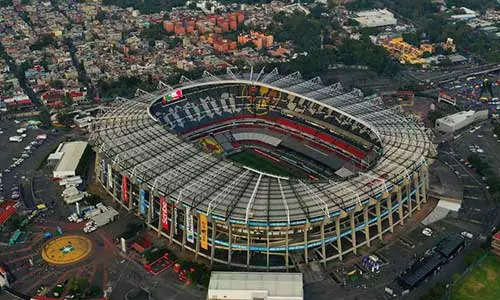
This legendary venue stands as a sacred temple of world football. Having witnessed Pelé lift the trophy in 1970 and Diego Maradona’s historic exploits in 1986, it will write history once again. In 2026, it becomes the first stadium to host matches in three separate World Cups, starting with the prestigious opening match.
Guadalajara Stadium (Estadio Akron)
Located in Zapopan, Estadio Akron is famous for its stunning architectural design, which resembles a volcano topped by a cloud-like roof. Home to the legendary club Chivas, this modern stadium provides a very intimate and loud environment for football fans.
Monterrey Stadium (Estadio BBVA)
Often referred to as “The Steel Giant,” Estadio BBVA is celebrated as one of the most visually breathtaking stadiums in the world. It is positioned with a stunning backdrop of the Cerro de la Silla mountain. Despite its beauty, it is also highly practical, offering top-tier amenities and a close-up fan experience.
Canada’s Modern Stadiums: The Northern Gateway
While soccer has traditionally shared the spotlight with ice hockey in Canada, the sport has experienced an immense surge in popularity. Consequently, Canada’s inclusion as a host nation is a landmark achievement. Here are the two Canadian stadiums selected:
Toronto Stadium (BMO Field)
BMO Field, situated beautifully on the shore of Lake Ontario, is the spiritual home of Canadian soccer. To meet FIFA’s capacity requirements, the venue has undergone significant expansions. Its intimate, English-style stands guarantee that spectators are always close to the action.
BC Place Vancouver
Located on Canada’s picturesque west coast, BC Place is a true architectural masterpiece. It features a state-of-the-art cable-supported retractable roof and a massive center-hung scoreboard. The vibrant city of Vancouver is widely known for its scenic beauty, making it a favorite destination for traveling international fans.
Sustainability in the FIFA World Cup 2026 Venues: Iconic Stadiums Hosting the Tournament
In addition to offering world-class sporting action, the organizers have placed immense emphasis on environmental sustainability. Because of the vast distances between host cities, reducing the overall carbon footprint of the event is a key priority. Consequently, several of the selected stadiums are leaders in eco-friendly operations.
For example, venues like Mercedes-Benz Stadium in Atlanta and Levi’s Stadium in California have achieved LEED Platinum and Gold certifications. These stadiums utilize advanced rainwater harvesting systems, solar panel arrays, and energy-efficient LED lighting. Meanwhile, local transport systems are being upgraded to ensure public transit is the preferred option for traveling supporters.
Ultimately, the goal is to set a new global benchmark for mega-sporting events. By demonstrating that high-capacity entertainment can coexist with strict environmental standards, these venues are laying the groundwork for future international tournaments. To see detailed planning documents, you can check the official FIFA portal.
Comparison of All 16 Host Stadiums
To help you quickly analyze the physical scale and roles of these outstanding structures, we have compiled a detailed comparison table below:
| Stadium Name (FIFA Name) | Host City & Country | Approx. Capacity | Key Tournament Role |
|---|---|---|---|
| New York New Jersey Stadium | East Rutherford, USA | 82,500 | Hosting the Final Match |
| Dallas Stadium | Arlington, USA | 92,900 | Semi-final Host |
| Mexico City Stadium (Estadio Azteca) | Mexico City, Mexico | 87,500 | Opening Match Host |
| Los Angeles Stadium | Inglewood, USA | 70,240 | US Team Debut Match |
| Atlanta Stadium | Atlanta, USA | 71,000 | Knockout Rounds & Semi-final |
| Seattle Stadium | Seattle, USA | 69,000 | Group Stage & Knockout |
| Boston Stadium | Foxborough, USA | 65,878 | Group Stage & Knockout |
| Houston Stadium | Houston, USA | 72,220 | Group Stage & Knockout |
| Kansas City Stadium | Kansas City, USA | 76,416 | Quarter-final Host |
| Miami Stadium | Miami Gardens, USA | 65,300 | Bronze Medal Match |
| Philadelphia Stadium | Philadelphia, USA | 69,796 | Group Stage & Round of 16 |
| San Francisco Bay Area Stadium | Santa Clara, USA | 68,500 | Group Stage & Round of 32 |
| Guadalajara Stadium | Zapopan, Mexico | 48,070 | Group Stage Matches |
| Monterrey Stadium | Guadalupe, Mexico | 53,500 | Group Stage & Round of 32 |
| Toronto Stadium (BMO Field) | Toronto, Canada | 45,000 | Canada Team Debut Match |
| BC Place Vancouver | Vancouver, Canada | 54,500 | Group Stage & Round of 16 |
Frequently Asked Questions (FAQ)
To further assist fans traveling or looking for information regarding the tournament sites, we have answered the most common inquiries below:
Which stadium is hosting the FIFA World Cup 2026 Final?
The highly prestigious final match of the 2026 FIFA World Cup will be hosted at the New York New Jersey Stadium (MetLife Stadium), located in East Rutherford, New Jersey.
What is the largest stadium among the FIFA World Cup 2026 venues?
Dallas Stadium (AT&T Stadium) has the largest overall capacity, holding over 90,000 spectators once specialized standing sections and configurations are fully optimized for soccer.
Will Estadio Azteca make history during this tournament?
Yes. Estadio Azteca will become the very first stadium globally to host matches in three separate World Cup editions (1970, 1986, and 2026).
Are the Canadian stadiums ready to host matches?
Absolutely. Both Toronto Stadium (BMO Field) and BC Place Vancouver have undergone modern upgrades and structural changes to meet strict FIFA regulations for pitch quality and spectator volume.
How were the host cities selected?
The cities were chosen based on rigorous standards, including existing state-of-the-art stadium technology, hotel capacity, international transport networks, and local soccer heritage.
Will all stadiums have natural grass?
Yes. FIFA requires that all competition matches be played on high-quality natural grass pitches. Consequently, venues that traditionally use synthetic turf are installing specialized turf-growing systems.
Conclusion and Final Thoughts
In conclusion, exploring the FIFA World Cup 2026 Venues: Iconic Stadiums Hosting the Tournament reveals the massive scope and ambition of this historic event. From the legendary grounds of Estadio Azteca to the ultra-modern luxury of SoFi Stadium, each venue is primed to deliver an unforgettable spectacle. This collaborative effort across Canada, Mexico, and the United States will unite fans globally, setting a spectacular standard for future tournaments.
Are you planning on traveling to witness history in person? Leave a comment below letting us know which stadium you are most excited to visit! Don’t forget to subscribe to our newsletter for exclusive stadium updates, ticketing news, and matchday tips.