FIFA World Cup Host Selection Process: Evolution Through the Years
The FIFA World Cup stands as the pinnacle of global sports, captivating billions of viewers every four years. However, the spectacle on the pitch is only half the story; the journey of choosing where the tournament takes place is a fascinating narrative of sports politics, modernization, and global development. Analyzing the FIFA World Cup Host Selection Process: Evolution Through the Years reveals how the tournament transformed from an invite-only gathering into a multi-billion-dollar global bidding war. As we explore this dramatic progression, we can better understand the shifting power dynamics of international football and how the host selection criteria have evolved to meet the demands of the modern era.
Table of Contents
- 1. Understanding the Host Selection Foundations
- 2. The Early Era of the FIFA World Cup Host Selection Process: Evolution Through the Years
- 3. Post-WWII Rotation and Geopolitics (1950–1998)
- 4. Reforming the FIFA World Cup Host Selection Process: Evolution Through the Years
- 5. The Modern Era: Transparency, Technical Scores, and Human Rights (2026 and Beyond)
- 6. The FIFA World Cup Host Selection Process: Evolution Through the Years and Future Horizons
- 7. Comparative Summary: Key Eras of FIFA Bidding
- 8. Conclusion & Key Takeaways
- 9. Frequently Asked Questions (FAQ)
1. Understanding the Host Selection Foundations
Before diving into historical specifics, it is essential to comprehend what the FIFA World Cup host selection process actually entails. Fundamentally, this process is the mechanism by which FIFA—football’s global governing body—decides which member association (or group of associations) will organize the tournament. Today, hosting is not just a sporting honor; it is a massive economic driver that can redefine a nation’s global image.
Historically, this choice rested in the hands of a small group of football executives. However, as the tournament grew in commercial value, the selection mechanism was forced to change. Consequently, the bidding rules have evolved from informal agreements into highly structured legal frameworks. To truly appreciate how we arrived at the current system, we must look back to the very beginning of the tournament’s history.
2. The Early Era of the FIFA World Cup Host Selection Process: Evolution Through the Years
The inaugural World Cup in 1930 was vastly different from the global spectacle we know today. At that time, FIFA did not have a structured bidding system. Instead, the selection was made via a direct vote during the FIFA Congress. Uruguay was selected as the first host primarily because they were the reigning Olympic champions and offered to cover all travel and accommodation costs for the participating teams.
Furthermore, Uruguay was celebrating its centennial of independence, which added a significant symbolic element to the bid. Despite these generous offers, travel remained a massive barrier. Historically, transatlantic travel required long, arduous journeys by boat, which deterred many European nations from participating. As a result, only four European countries made the trip to Montevideo.
Subsequently, the selection of Italy for the 1934 edition and France for the 1938 edition generated substantial political tension. South American nations felt that the tournament should alternate strictly between Europe and South America. Therefore, when France was awarded the 1938 tournament, both Uruguay and Argentina boycotted the event in protest. This early phase demonstrated that without a clear, formalized rotation policy, the FIFA World Cup host selection process would inevitably suffer from intense regional disputes and logistical boycotts.
3. Post-WWII Rotation and Geopolitics (1950–1998)
Following the devastation of World War II, FIFA sought to stabilize the tournament by addressing the geographical grievances of the past. To avoid further boycotts, an informal rotation agreement was established between Europe and South America. Consequently, the tournament alternated between these two continents for several decades, beginning with Brazil hosting in 1950 and Switzerland in 1954.
During this era, the responsibility for choosing hosts shifted away from the full FIFA Congress to the much smaller and more powerful FIFA Executive Committee (ExCo). This committee comprised a select group of continental representatives who held immense sway over the sport’s destiny. Meanwhile, global interest in football was skyrocketing, prompting other regions to demand a seat at the table.
In addition, the commercialization of the sport began to pick up speed. Mexico’s selection in 1970 marked a significant step forward, as it was the first tournament broadcast in color to a global audience. When Colombia was forced to withdraw as the 1986 host due to severe economic difficulties, the ExCo quickly stepped in and selected Mexico once again. This decision highlighted the growing importance of infrastructure and financial guarantees, elements that would soon become central to the modern FIFA World Cup host selection process.
4. Reforming the FIFA World Cup Host Selection Process: Evolution Through the Years
As the 20th century drew to a close, the commercial value of the World Cup reached unprecedented heights. Bidding wars became highly professionalized affairs, with governments spending millions of dollars just to secure the hosting rights. This intensive competition reached a boiling point in 2010 during the infamous dual vote for the 2018 and 2022 tournaments.
In a historic move, the 24-member FIFA Executive Committee voted simultaneously on two tournaments. Russia was awarded the 2018 edition, while Qatar secured the 2022 tournament. This decision shocked the sporting world and immediately sparked intense scrutiny. Critics argued that the highly concentrated voting power of the ExCo made the entire system vulnerable to lobbying, backroom deals, and outright corruption.
Consequently, these controversial selections triggered extensive investigations by international law enforcement agencies. The ensuing scandals led to the arrest of multiple high-ranking football officials and forced a complete institutional overhaul. Ultimately, this dark period proved that the traditional FIFA World Cup host selection process was no longer viable. Therefore, sweeping reforms were introduced to restore credibility to the bidding system.
5. The Modern Era: Transparency, Technical Scores, and Human Rights (2026 and Beyond)
In response to the corruption scandals, FIFA fundamentally restructured the voting process. Under the leadership of Gianni Infantino, the power to select host nations was stripped from the Executive Committee and returned to the full FIFA Congress. Today, all 211 member associations cast a vote, and each ballot is made public to ensure maximum transparency.
In addition to democratic voting reforms, FIFA introduced a rigorous technical evaluation system. Bidders are now graded on a point system across multiple critical criteria, including:
- Infrastructure: Quality of stadiums, transport networks, and media facilities.
- Accommodation: High-quality hotel capacity for teams, officials, and millions of fans.
- Commercial Potential: Projected revenue generation from ticket sales and local sponsorships.
- Sustainability and Human Rights: Explicit, legally binding commitments to labor rights and environmental protections.
These new regulations were put to the test for the first time during the bidding for the 2026 tournament. The joint “United Bid” from the United States, Canada, and Mexico successfully defeated Morocco’s solo bid in a transparent vote. Crucially, the 2026 tournament also marked the expansion of the World Cup to 48 teams. Consequently, the sheer scale of the event means that multi-nation, co-hosting bids have transitioned from a rare exception to a practical necessity for most regions.
6. The FIFA World Cup Host Selection Process: Evolution Through the Years and Future Horizons
As we look to the future, we can observe that the FIFA World Cup host selection process continues to adapt to changing geopolitical realities. The decisions surrounding the 2030 and 2034 tournaments reflect a highly strategic approach to geographical rotation and historical celebration.
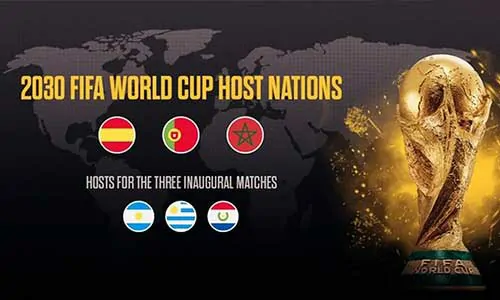
For the 2030 tournament, FIFA approved a highly unique, multi-continental concept. The primary hosting rights were awarded to a joint bid from Morocco, Portugal, and Spain. However, to celebrate the centenary of the first World Cup, the tournament will feature three special opening matches in Uruguay, Argentina, and Paraguay. Consequently, this hybrid tournament will stretch across three continents, combining historical tribute with state-of-the-art European and African infrastructure.
Furthermore, this decision had a direct impact on the 2034 host selection. Because the 2030 tournament involves associations from UEFA, CAF, and CONMEBOL, and the 2026 tournament is hosted by CONCACAF, FIFA restricted the eligibility for 2034 to member associations from the Asian Football Confederation (AFC) and the Oceania Football Confederation (OFC). Ultimately, Saudi Arabia was confirmed as the sole bidder and formally selected as the host for the 2034 edition, demonstrating how strategic rotation rules can streamline the selection timeline and shape the global map of football.
7. Comparative Summary: Key Eras of FIFA Bidding
To help visualize this long-term progression, the table below outlines the core differences between the different eras of the FIFA World Cup host selection process:
| Era | Primary Voting Body | Key Selection Criteria | Notable Hosting Examples |
|---|---|---|---|
| Early Era (1930–1938) | FIFA Congress | Financial promises, symbolic anniversaries, geographic lobbying. | Uruguay 1930, Italy 1934 |
| Rotation Era (1950–1998) | Executive Committee (ExCo) | Informal alternation between Europe and South America. | Brazil 1950, West Germany 1974 |
| Commercial & Scandal Era (1998–2022) | Executive Committee (ExCo) | Highly competitive bidding wars, infrastructure capacity, political lobbying. | South Africa 2010, Qatar 2022 |
| Modern Era (2026–Present) | All 211 Member Associations | Public voting, strict technical scoring, sustainability, human rights. | USA/Canada/Mexico 2026, Morocco/Spain/Portugal 2030 |
8. Conclusion & Key Takeaways
The history of football’s greatest tournament is intrinsically linked to the FIFA World Cup Host Selection Process: Evolution Through the Years. What began as a simple vote among a handful of delegates has evolved into an incredibly complex, data-driven, and politically charged global campaign. By shifting the vote to all 211 member associations and introducing mandatory technical and ethical criteria, FIFA has taken significant strides to clean up the process and establish transparency.
Nonetheless, as the scale of the tournament expands to 48 teams, the operational demands on host nations will only increase. This reality suggests that the future of the World Cup will likely feature more collaborative joint bids spanning multiple countries, and perhaps even continents. For fans and analysts alike, keeping a close eye on these procedural shifts is key to understanding where the beautiful game will head next.
What are your thoughts on the modern bidding system? Do you think joint, multi-continental hosts are the right direction for the sport, or do you prefer the classic single-country model? Share your opinions in the comments below!
9. Frequently Asked Questions (FAQ)
Q1: How was the very first FIFA World Cup host chosen?
A1: The first host, Uruguay, was selected in 1930 by a vote of the FIFA Congress in Barcelona. Uruguay was chosen because they were the reigning Olympic champions and generously offered to pay all travel and lodging costs for the participating teams.
Q2: What was the informal rotation policy in the mid-20th century?
A2: Following several boycotted tournaments in the 1930s, FIFA established an informal agreement to alternate hosting duties strictly between Europe and South America. This rotation policy helped stabilize the tournament for several decades after World War II.
Q3: Why was the FIFA Executive Committee stripped of its voting power?
A3: The 24-member Executive Committee (ExCo) was stripped of its voting power following massive corruption scandals surrounding the dual 2018/2022 hosting votes. To restore integrity, FIFA changed the rules so that all 211 member associations could vote publicly.
Q4: How does the modern technical evaluation system work?
A4: Bidding nations are now subjected to a strict inspection by an independent FIFA task force. Bids are scored on key elements like stadium infrastructure, transport networks, fan accommodations, and commercial revenue potential, alongside legally binding human rights reviews.
Q5: What makes the 2030 FIFA World Cup hosting selection unique?
A5: The 2030 tournament features an unprecedented multi-continental format. While Morocco, Portugal, and Spain are the primary joint hosts, Uruguay, Argentina, and Paraguay will each host a single centennial match to mark 100 years of the World Cup.
Q6: Why is Saudi Arabia the sole bidder for the 2034 World Cup?
A6: Due to FIFA’s strict geographical rotation rules, only member nations from the Asian Football Confederation (AFC) and Oceania Football Confederation (OFC) were eligible to bid for 2034. Saudi Arabia declared its candidacy immediately, and no other country submitted a competing bid before the deadline.